One window for the work
Todos, projects, skills, and sessions live together, so you are not hopping across a pile of tools.
v0.7.3 · macOS Apple Silicon
A local-first workbench for a one-person company — kernel plus occupation plugins.
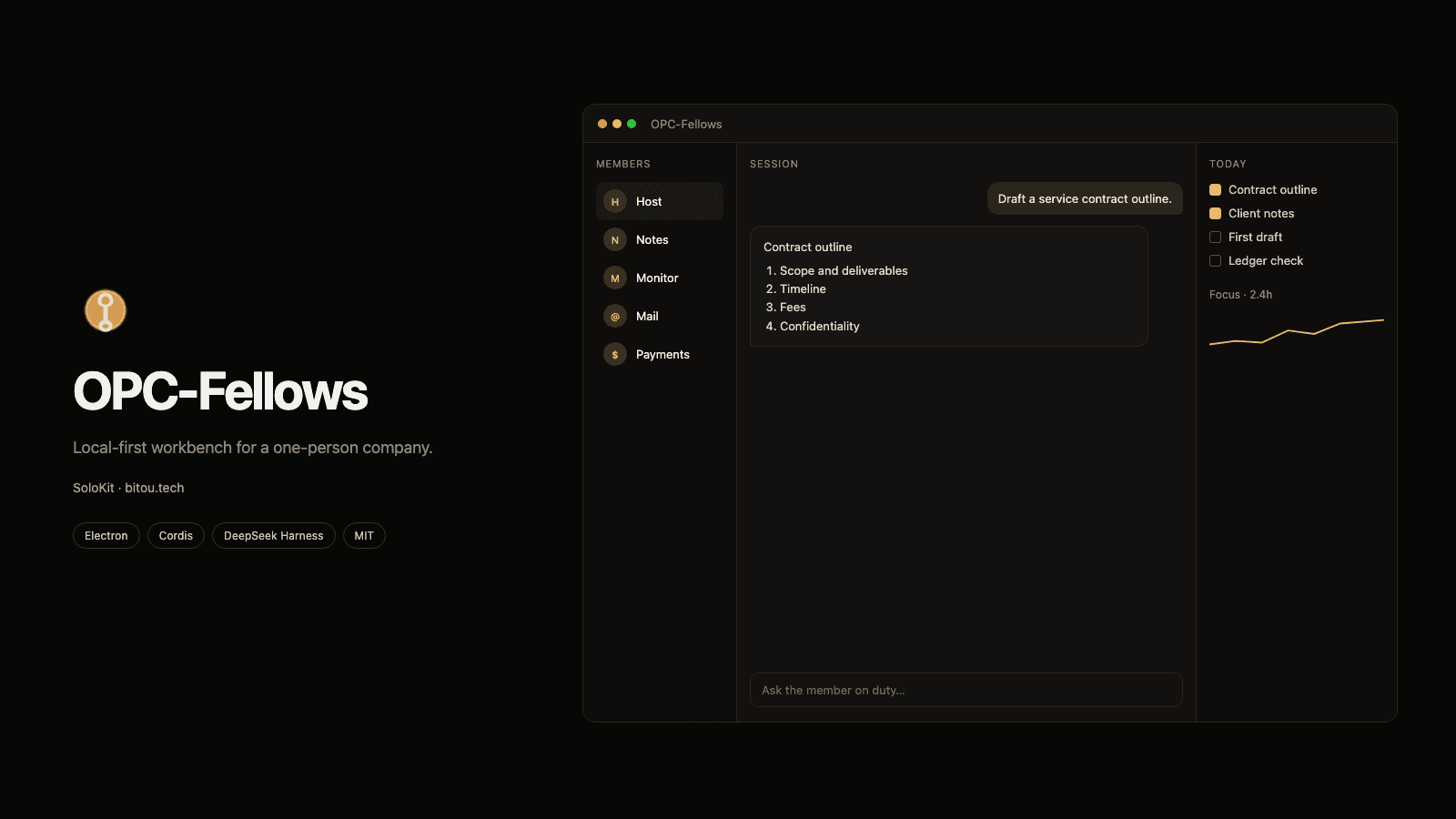
Keep the todos, projects, skills, and sessions of a one-person company in one local window.
Todos, projects, skills, and sessions live together, so you are not hopping across a pile of tools.
Turn notes, mail triage, growth experiments, and other occupation modules on only when the work needs them.
Business data lives in local userData. There is no first-party backend holding it for you.
Only macOS (Apple Silicon) builds are available. Windows and Linux are not available yet.
Drag the app into Applications.
Unzip to get the same macOS app, handy for copying or archiving.
You must allow it on first launch
This build is not Apple-signed or notarized. macOS will block the first open until you run the command below, then launch the app.
xattr -cr "/Applications/OPC Agent Team - Solokit.app"About the app display name After install, Dock and Applications still show “OPC Agent Team - Solokit”. Renaming it would migrate the data directory, so that waits for a later release.
latest-mac.yml — latest-mac.yml is this release’s macOS update manifest.
The Cordis kernel owns the session and permissions. Occupation modules plug in through a contract and cannot call past it.
A module declares the capabilities it needs in its manifest.
Calls outside that grant are rejected by the kernel.
High-risk permissions are confirmed when the module is installed.
This is the real module list from the project README — nothing added or removed.
Local notes
Standalone reminder window; due todos jump to screen center
Repo / site posture; optional GET /api/stats
Multi-platform copy from product capabilities
Public-forum pain points clustered into product ideas
Experiments, loops, and channels; no copy, no traffic refresh
Domestic-platform accounts and day logs (manual data)
Local read-only bridge to WeChat Intelligence Hub; never sends WeChat, chats stay on device
Local Mail.app + iCloud / Gmail / QQ IMAP; triage and drafts only, no sending
Local ledger; optional Creem sync
Center-pane chat and Local API share one SDK session
Permissions follow a capability allowlist. Chats, mail, and secrets stay on this machine by default.
Business data stays in local userData. There is no first-party backend.
WeChat intel is a local read-only index: chats are not uploaded, secrets never leave the machine, and the app never sends WeChat messages.
Mail only reads the inbox and writes local drafts. The app does not send mail.
Third-party modules go through a capability allowlist. High-risk permissions are confirmed at install time.
The published installer is macOS (Apple Silicon) only. Windows and Linux are not available yet.
The build is not Apple-signed or notarized, so the system blocks the first launch. Run xattr -cr "/Applications/OPC Agent Team - Solokit.app" in Terminal, then open the app.
Business data stays in local userData. There is no first-party backend. WeChat chats and secrets do not leave this machine; mail drafts are local too.
Yes. The project is MIT-licensed, which allows commercial use. The LICENSE file in the repo is the source of truth.
See CONTRIBUTING in the public repo. Modules declare capabilities in a manifest; the kernel rejects out-of-grant calls; high-risk permissions are confirmed at install time. Read CONTRIBUTING